

dancing with broken equations
the intersection of chemistry and dance

In quantum mechanics and chemistry, the Heisenberg Uncertainty Principle states that you cannot know a particle’s position (x) and its momentum (p) with perfect precision at the same time. The more you know about one, the less you know about the other. This limit is not due to experimental error but instead is an intrinsic property of all quantum systems, defined mathematically by the equation: ∆x · ∆p ≥ ħ/2.
Determining ∆x
To understand the uncertainty principle, you start by finding x. You look for where a particle exists in space at a specific moment and mark its position as precisely as you can. It’s almost like dancing. Stand in front of a mirror and learn exactly where your body belongs. Notice how far your leg extends in a tendu, the rotation of your knee in an arabesque, and the orientation of your hips in a développé. Examine yourself harshly and keep adjusting because precision feels safe to you: if the particle is here, then it is not lost. If your shoulders stay down and your ribs stay closed, then you are doing something right, because this is the version of dance that everyone praised. Stand anxiously at the barre, hands gripping the splintered rod of wood so tight that your knuckles turn white, and watch teachers walk around with rulers in their hands. Shudder, but say nothing, as your teachers poke and prod on your body, correcting each angle by the degree, only because you wanted to become the perfect solution to their equation. At first, this part seems so simple. You think that if you keep tracking x, everything else will fall into place, that you will find the perfect musicality for every movement, and an ideal version of yourself will appear. Yet the more tightly you hold onto your position, the looser your grip becomes. You fix one thing, and another quickly drifts. Your turnout fades as your balance improves, your elbows droop as your neck lengthens. Notice how precision slips away so quickly when your muscles cramp or when your heart beats a little too loudly in your ears. During performances, hold a practiced smile through standing ovations, feeling a strange hollowness behind the applause as you hit every shape, every line, and every frame with textbook accuracy. You want to believe, so badly, that knowing where you are is enough, but location itself feels like a dead end. You reach every mark but forget to breathe, and focus so hard on being correct that you forget to dance. The first component of the uncertainty principle tells you where a particle is, yet it cannot tell you where it’s going. Position without motion, is a body without a soul.
Determining ∆p
Once you have located x, the uncertainty principle tells you that you must also consider p, momentum. Not where a particle is, but how it moves. In dance, this is where you stop staring at the mirror and start listening to the music. You stop questioning whether the line is perfect and start asking whether it feels like anything at all. Dance in hallways and living rooms, improvising choreography late at night as the world around you quiets down. Momentum is the spark that allowed you to fall in love with dance when you were young, spinning in circles with a glittery silk scarf long after the music stopped. Allow the beat to carry you, and let your heartbeat become the counts. That is called passion. Yet when you care this much, p can turn dangerous. You push harder, not because you’re inspired, but because you’re afraid of falling behind. Practice does not stop when rehearsal ends. You repeat combinations in the dimly lit studio at midnight, until your toenails bruise and bleed and break into shattered fragments that once inhabited the pointe shoes you loved. You stretch through immense pain, your muscles screaming for mercy as tendons pull taut between agony and art. Obsession disguises itself as dedication, and you applaud it until the day your body buckles under its weight. When you are purely guided by momentum, direction slips away. You move faster and faster, convinced by peers and family that speed equals success. Your body lunges toward something you can’t yet name, too focused on acceleration to recognize friction. Eventually, you sense that what’s missing isn’t more and more motion but balance, a steadiness that speed alone can’t provide. The uncertainty principle explains why this happens: the more precisely you try to measure your momentum, the less you can know about your position. You finally understand that passion is movement fueled by love, while obsession is driven by fear. By realizing that, you change the equation again: the second step of solving it reveals that motion matters, but it cannot be the whole answer.
The Planck’s Constant: ħ/2
The last step in the equation is the reduced Planck’s constant, ħ divided by 2. No matter how carefully you measure x, how intensely you chase p, this number remains unchanged. You slowly realize that uncertainty is inevitable, that you cannot be perfectly precise and perfectly free at the same time.
So allow the relentless motion to catch up to you. Fracture your ankle during the most important year of your dance career. Watch your peers win the most prestigious competitions that you were supposed to attend. And you try to push, but your body refuses to obey. The constant is a reminder that some things cannot be rushed or controlled. It teaches that dance is not built solely on flawless artistry and rigid control, but instead on the ability to negotiate with yourself. You learn that healing is not failure, and rest can be a form of your devotion to dance.
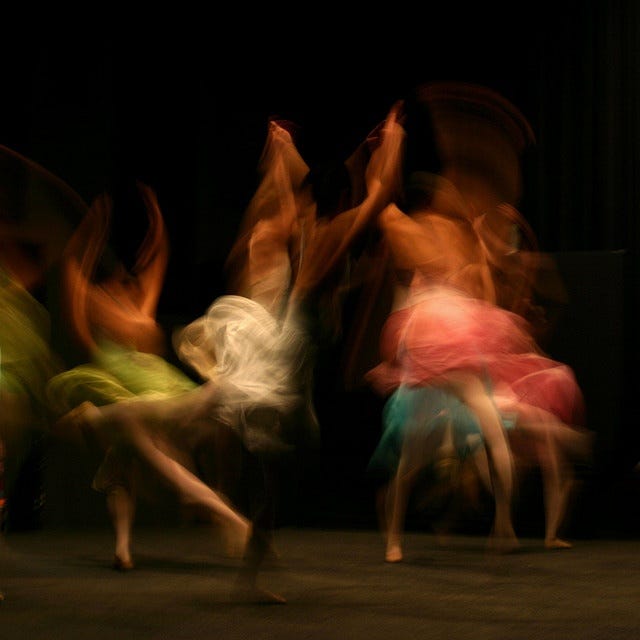
Now bring it together with x times p. The product of momentum and position does not require perfection. It is ever so alive, changing, and uncertain, shifting and adapting with every choice and even every misstep. You start to see that uncertainty is not the enemy, but a space to grow. Precision without passion leaves you hollow; passion without limit leaves you lost. To dance is to live within the Heisenberg uncertainty principle itself, to move where the position blurs into momentum, and let that blur become beauty. You step onto stage one last time before leaving the dance company that shaped you, knowing you’ll never fully know what comes next. The music begins anyway. You lift your chin high, allow uncertainty to guide you, and choose to dance from your soul.